
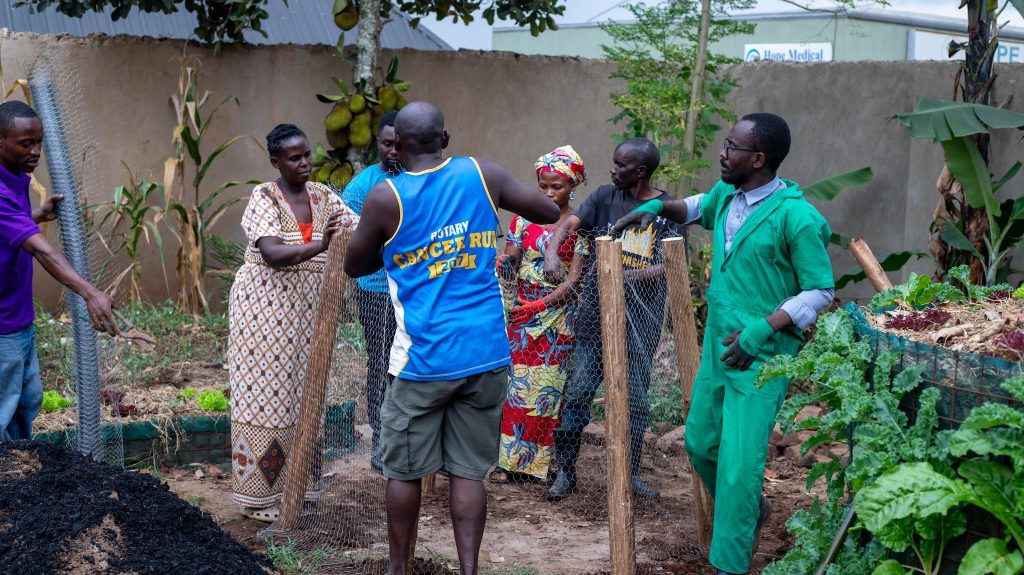
August 16, 2025 | Gayaza, Kampala, Uganda
There is a particular kind of joy that comes when years of quiet dreaming suddenly take shape in your hands — when soil, community, and purpose finally align. That is exactly what happened on the morning of August 16, 2025, in the Gayaza Neighbourhood Garden in Kizawula Bukemba, Kampala, Uganda.
Members of six communities gathered with tools, food, and full hearts to officially launch the Regenerative Life Garden (RLG) Climate Quest — a project born from lived experience, shaped by global collaboration, and rooted in the belief that every household can become a climate hero.
The Roots of the Idea
The Regenerative Life Garden did not start in a boardroom or a research lab. It started with hunger.
David Munezero grew up in Rwanda, shaped by poverty, displacement, and the shadow of genocide and wars. When he arrived in Uganda and began working with the Jesuit Refugee Service Kampala, he spent three years training urban refugees and vulnerable communities in urban farming. Through that work, he became intimately familiar with two garden models — the Tower Garden, a vertical structure using stones at the center for drainage and aeration, and the Keyhole Garden, a ground-level design with a composting chamber at its heart.
One day, he asked himself: What if you could combine them?
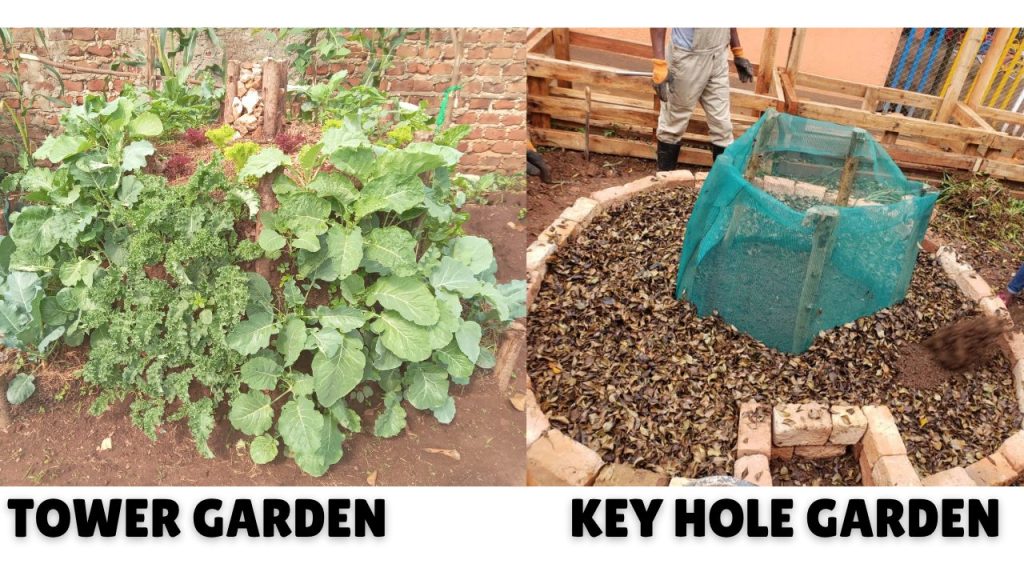
The result was a vertical garden with a composting area at the center instead of stones — a structure that didn’t just grow food, but processed kitchen waste into rich compost, fed itself, and produced continuously.
The first version was installed at the JRS Kampala kitchen, where it grew sukuma wiki, kale, cucumbers, spring onions, and lettuce for two years, while turning tonnes of kitchen waste into compost manure. He called it the Regenerative Kitchen Garden.
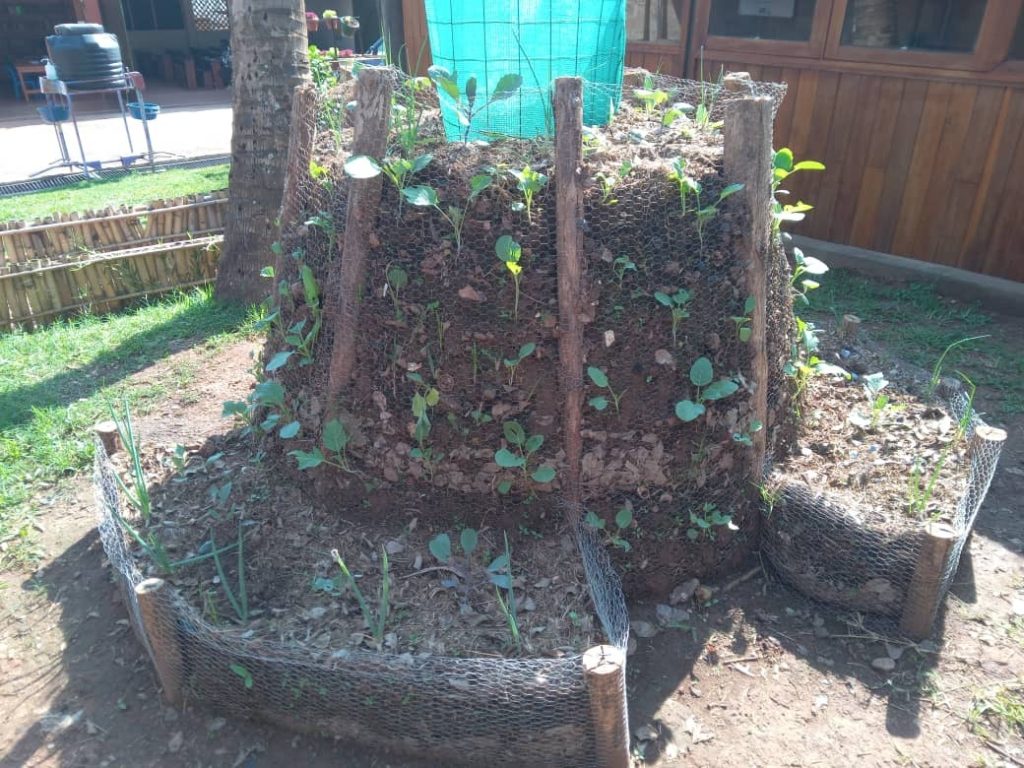
The first RLG set in Jesuit Refugee Service Kampala in 2023
Then, in May 2025, everything accelerated.
A Quest Becomes a Movement.
Completing the RegenIntel Foundations Course — a programme run by Regenerative Intelligence, an organisation on a mission to activate humanity to become a planet-positive species — David was asked to present a regenerative project as his Climate Quest.
Nothing else came to mind but his garden.
He renamed it the Regenerative Life Garden, because it put life at the center — not just food, but community, climate, soil health, and human dignity. The presentation lit something up. Fellow participants encouraged him, offered ideas, and some supported him financially. That support marked the true beginning.
Through the RegenIntel community, David connected with two co-creators who would become essential to the journey: Iyanuoluwa Fatunmbi, a spatial technologies specialist with expertise in GIS and urban green infrastructure based in Nigeria and USA, and Alessandra Vega (Ale), a content and communications creator joining from Nicaragua.
Together, they formed a team across three continents. Dr. Mamta Mehra, co-founder of RegenIntel, accepted the invitation to join as advisor. They were ready.
The Day of the Launch
The morning of August 16th arrived with clouds heavy with rain — a blessing and a challenge in equal measure.
Communities from across Kampala made their way to the Gayaza Neighbourhood Garden: members from Nyago Community Garden, Nsambya Community Garden, Nabulagala Single Mother Garden, Gayaza Neighbourhood Garden, Bulaga Community Garden, and Kisenyi Community Garden.
They came with tools, with curiosity, and with the generosity of people who understand what it means to solve problems together.
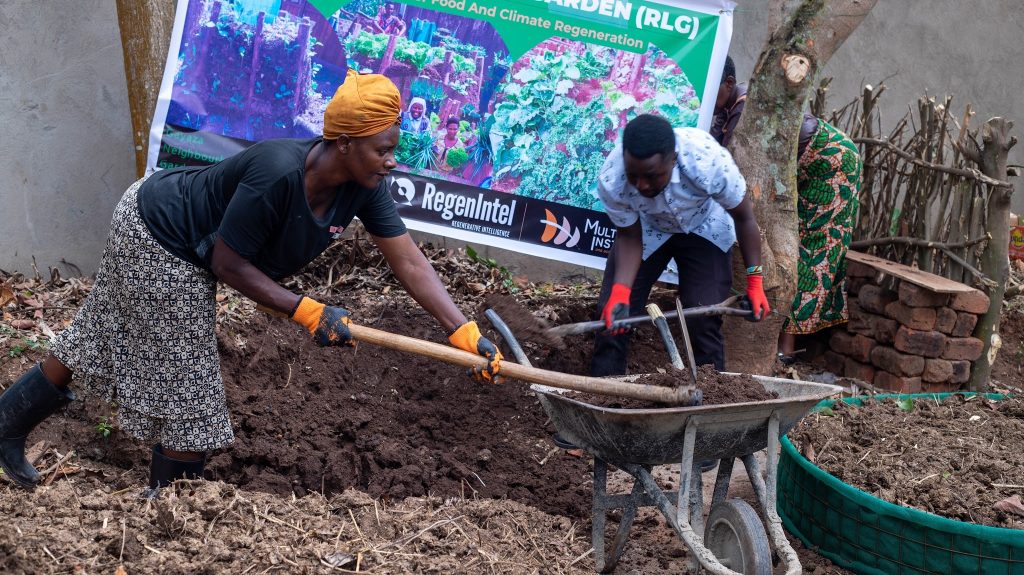
The morning began with arrival and welcome, introductions, and the sharing of stories. David spoke about the vision he had been carrying for years — of a world where every household grows its own food while contributing to climate action. Of gardens that solve multiple problems at once: food security, waste management, carbon sequestration, community resilience. He called it multi-solving — a concept championed by their partners at the Multi-Solving Institute — and he invited everyone present to walk the journey together. They pledged to do just that.
Breakfast was shared. Then came the work.
Hands reached for poles, biochar, compost, soil, and wire mesh. A new RLG was being built — a vertical structure filled with a carefully mixed blend of soil, compost manure, biochar, and sand. The biochar, produced on-site, is not just a soil amendment; it is a carbon sink capable of sequestering carbon for a hundred years or more. At the center of the structure sits the composting chamber, where kitchen scraps will transform into nutrients that feed the garden back.
The rain came down hard that afternoon, and the group could not finish the garden before evening — but no one left discouraged. The rain was celebrated as a sign of life.
A Global Circle Gathers
At 4 PM, the electricity went out across the area. Rain drummed on the roof. And yet, in a darkened room in Gayaza, a laptop opened and a Zoom call began.
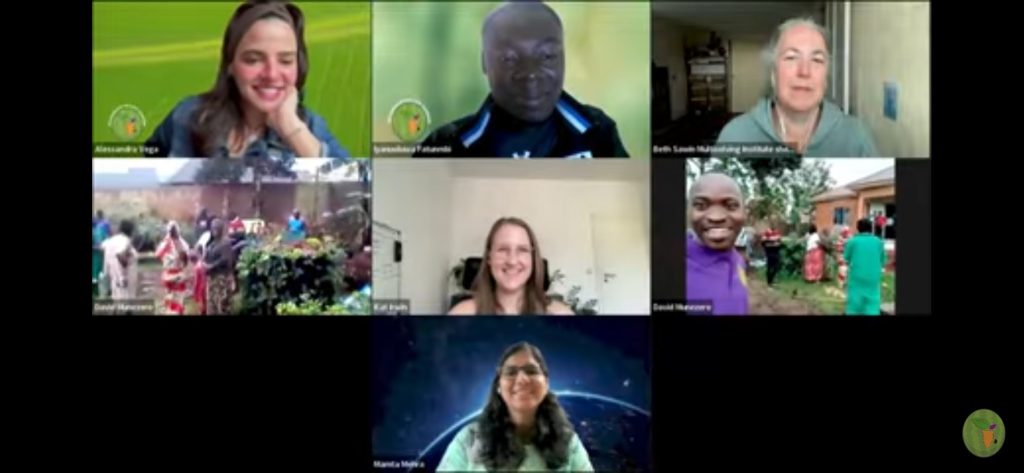
Despite intermittent connectivity, despite the storm, the team connected with partners and supporters around the world for an intimate virtual gathering to mark the launch. The people who joined that call understood what was happening in that garden, and why it mattered.
Iyanuoluwa Fatunmbi described why he had joined the quest: having lived in both rural and urban environments, he had seen food abundance wasted in one place while people paid dearly for poor-quality vegetables in another. RLG, he said, was exactly the kind of multi-solving vision you cannot walk past. He painted a picture of what could be — entire communities dotted with vertical gardens, households cutting food bills, cities growing resilient from the ground up, with cascading benefits that reach across the Sustainable Development Goals.
Alessandra Vega (Ale) spoke of RegenIntel’s deeper mission — moving away from systems of exploitation and extraction toward a world where humanity works in concert with nature. She quoted Elizabeth Sawin: “Working in isolation makes us weak.” And she described what brought the three co-creators together — not just shared goals, but genuine conversations, heard stories, and the recognition that their different skills — David’s ground-level agricultural expertise, Iyanuoluwa’s spatial technologies, and Ale’s communications and creative design — could combine into something greater than any one of them alone.
Dr. Mamta Mehra, co-founder of RegenIntel, offered words of pride and practical wisdom. She spoke of the satisfaction of watching three fellows take the mission of the course and manifest it in the real world. She encouraged the team to clarify their call to action, to document beautifully, to consider hackathons and workshops as ways to engage the broader community, and to expand the advisory board. She confirmed her own seat on it with joy. “The steering is in your hand,” she told them. “We are all here to support you.”
Elizabeth Sawin, founder of the Multi-Solving Institute and author of Multisolving: Creating Systems Change in a Fractured World, offered something more elemental: a reminder that this work belongs to a hidden global movement. Innovators all over the world, she said, are figuring out — not always easily, with commitment and patience — how to advance food, climate, health, and justice together. She welcomed the team to that movement, not as newcomers, but as fellow travellers.
“Your successes will be everyone’s successes. And the things you do that won’t work — those are very valuable too, because we don’t have time to all make the same mistakes.”
— Elizabeth Sawin, Multi-Solving Institute
The call also touched on the future. Iyanuoluwa described plans to use GIS and satellite imaging to spatially map the distribution of RLGs across communities and track their environmental impact over time — measuring urban heat reduction, biodiversity, and soil health before and after installation.
Dr. Mamta suggested geo-locating each garden with community mobile phones, creating before-and-after imagery, and using the multi-solving flower tool to visualize how the petals of impact develop over time. The vision grew in real time.
From the Garden, David Spoke
Then the rain eased. The power was still out. And David and community members walked to the garden.
Holding up the phone to the camera, soaked and smiling, David showed the world what they had been building. Version one of the RLG: a structure of wooden poles and wire mesh, filled with the soil-compost-biochar-sand mixture, composting area at the center.
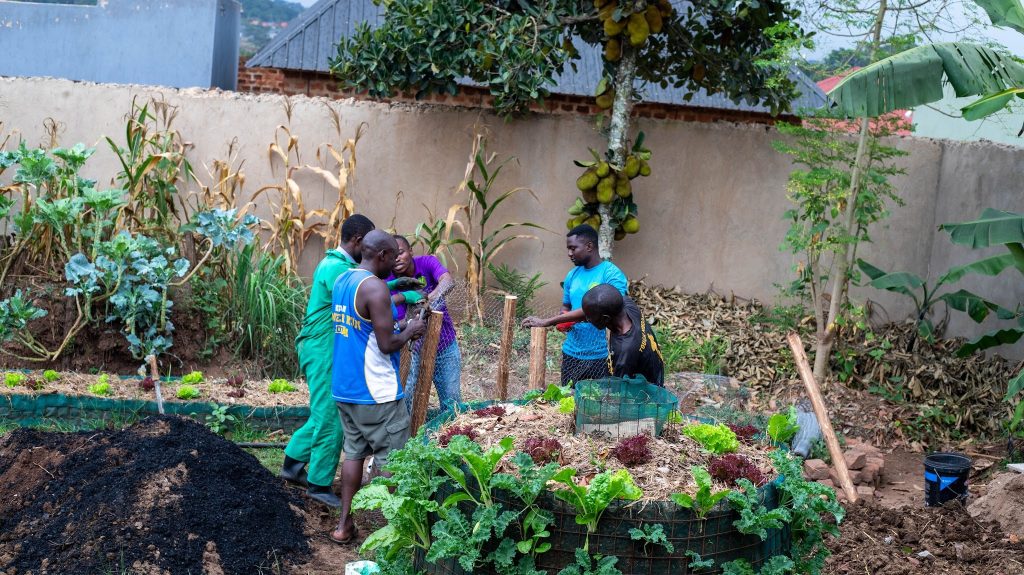
Version two, already established nearby: lush with collard greens, Swiss chard, lettuce red and green, kale, and spring onions. A Moringa tree. Banana. Avocado along the fence.
He explained how the gardens worked — crop rotation, continuous harvesting by plucking leaves rather than uprooting plants, composting kitchen waste into the center chamber. The perennial varieties like collard greens and kale had been producing for two years already in Jesuit Refugee Service Kampala and would continue for a third.
When renewal was needed, the wire mesh would be disassembled, the soil refreshed with compost and biochar, and the cycle would begin again.
Hands were clapping on the Zoom call. Dr. Mamta asked a quiet question: “How lucky are the people who are with you right now? They could have a nice dinner from everything you’ve grown.”
What Comes Next
The Regenerative Life Garden Climate Quest Pilot project is a six-month project, with a plan to install 20 RLGs across communities in Kampala, train as many people as possible, and build partnerships with schools, NGOs, and neighbourhood groups. The goal is to reach at least 5,000 people — though the real number, once community sharing begins, will be far greater.
It is a project that costs very little and gives back in abundance. One supporter on the call — hearing about the gardens for the first time — immediately asked how much it would cost to sponsor a single garden and proposed naming it after her community.
A crowdfunding platform is live at rlgearth.com, and every contribution directly funds a garden, seeds, tools, and training.
David closed the virtual gathering with words that captured everything:
“My vision is to see every household become a climate hero while they are solving their own problems. A person can provide vegetables for their family — and at the same time, contribute to climate change mitigation. That is the goal.
You Are Invited
The Regenerative Life Garden is more than a garden. It is a model, a movement, and an open invitation.
If you are a community, a school, an NGO, or an individual who wants to link arms — the door is open. If you want to sponsor a garden, the link is waiting. If you want to replicate this model in your own city, the documentation is being built, the stories are being gathered, and the team is ready to share everything they learn.
The soil is ready. The seeds are in. The rain has come.
Now it is time to grow.
Co-creators: David Munezero (Uganda), Iyanuoluwa Fatunmbi (Nigeria & USA), Alessandra Vega (Nicaragua)
Advisor: Dr. Mamta Mehra, Co-Founder, RegenIntel
Partners: RegenIntel | Multi-Solving Institute | Mchanga Africa